
 Navajo Rug Appraisal Co.
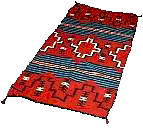 Navajo Rug Appraisal Co.
The Navajo Nation (Dine'é in Navajo language) is a Native American sovereignty. The Navajo Reservation covers about 27,000 square miles (70,000 square kilometres, 17 million acres) of land, occupying all of northeastern Arizona, and extending into Utah and New Mexico, and is the largest land area assigned primarily to a Native American jurisdiction within the United States. Members of the nation are often known as Navajo (or Navaho) but traditionally call themselves Diné (sometimes spelled in English as Dineh) which means people.
The 2000 census reported 298,215 Navajo people living throughout the United States, of which 173,987 were living within the Navajo Nation boundaries, 131,166 lived in Arizona and 17,512 of these lived in Maricopa County, which includes the city of Phoenix. Because the Navajo Nation encompasses land in three states, its Division of Economic Development extracts census data for the Navajo Nation as a whole, and sends a representative to the Census Board. Another group lives on the Colorado River Indian Tribes reservation along the Colorado River in California and Arizona.
Geography
The Nation's boundaries abut the Ute Nation at the Four Corners Monument and stretch across the Colorado Plateau into Arizona, Utah, and New Mexico. Located within the Navajo Nation are Canyon de Chelly National Monument, Monument Valley, Rainbow Bridge National Monument, the Hopi Indian Reservation, and the Shiprock landmark. The seat of government is located at the census-designated place of Window Rock in Apache County, Arizona. There are several adjacent "Navajo Indian Reservations" (such as Alamocita) in this area, but generally function as sub-units of the "Big Rez" with considerable local autonomy). The Diné's traditional boundaries are the four sacred mountains, which actually include an area much larger than the present-day reservation. The eastern portion of the reservation, located in New Mexico is popularly called the "Checkerboard" because Navajo lands are mingled with fee lands (owned by both Navajo and non-Navajo people) and federal and state lands under various jurisdictions. Large non-contiguous sections of the Navajo Nation in New Mexico are: Ramah Navajo Indian Reservation in western Cibola County and southern McKinley County; Alamo Bend Navajo Indian Reservation in northwestern Socorro County; and Canoncito Indian Reservation in western Bernalillo County and eastern Cibola County. The total land area of the reservation is 62,362.062 km² (24,078.127 sq mi), making it by far the largest Indian reservation in the United States. It is almost exactly the same size as the state of West Virginia; it is slightly larger in land area, but slightly smaller if water area is included. Its resident population was 180,462 as of the 2000 census. Coincidentally, this was almost exactly one-tenth of West Virginia's population at the same time.
Other Amerind tribes are located in this area, including several Pueblo nations: Congress established a Hopi (Navajo, Oozéí, or Ayahkinii "underground-house-people") reservation within the Navajo reservation at an historic homeland where Hopi history predates that of Diné in the area. Adjacent or nearly adjacent to the Navajo Reservation are the Southern Ute of Colorado, the Ute Mountain Ute Tribe of Colorado, Utah, and New Mexico, both to the north; the Jicarilla Apache to the east, and other tribes to the west and south. A conflict over shared lands emerged in the 1980s, when the Department of the Interior attempted to relocate Diné living in the Navajo/Hopi Joint Use Area. The conflict was resolved, or at least forestalled, by the award of a seventy-five-year lease to Diné who refused to leave the former shared lands.
History
Linguistic similarities indicate the Navajo people and Apache were once a single ethnic group. They speak dialects of the language family referred to as Southern Athabaskan or Apachean. Non-Navajo ethnologists speculate they moved into what would become the American Southwest sometime after 1000 AD.
Trade between the long-established Pueblo and the Apachean peoples became important to both groups by the mid 1500s. The Spanish noted that the Pueblos exchanged maize and woven cotton goods for bison meat, hides and material for stone tools. There was also some trade (and raids) between the Spanish colonists along the Rio Grande valley, especially in sheep and horses. Francisco Vásquez de Coronado observed Plains people wintering near the Pueblos in semi-established camps. The Spanish first mention the "Apachu de Nabajo" (Navajo) in the 1620s, referring to people in the Chama valley region east of the San Juan River. By the 1640s, the term was applied to Athabaskan peoples living in what is now Western New Mexico and Eastern Arizona.
Tribal Membership
Each tribe establishes its own requirements for being an enrolled tribal member, which is usually based on "blood quantum." The Navajo Nation requires a blood quantum of one-quarter for a person to be an enrolled tribal member and to receive a Certificate of Indian Blood (CIB). In comparison, some tribes require a 1/32 blood quantum for issuing a CIB. In 2004, the Navajo Tribal Council voted down a proposal to reduce the blood quantum to one-eighth, which would have effectively doubled the number of individuals qualified to be enrolled Navajo tribal members.
Government
Diné government is unique in several ways. Formally established in 1923, The Diné have three times refused to establish a new government under the Indian Reorganization Act of 1934. Members twice rejected constitutional initiatives offered by the federal government in Washington, first in 1935 and again in 1953. A reservation-based initiative in 1963 failed after members found the process to be too cumbersome and a potential threat to their self-determination. A constitution was drafted and adopted by the governing council but never ratified by the members. The earlier efforts were rejected primarily because members did not find enough freedom in the proposed forms of government to develop their livestock industries, in 1935, and their mineral resources, in 1953.
The Navajo Nation is divided into five Agencies (which match the five Bureau of Indian Affairs (BIA) agencies which support the Nation) and 110 Chapters, analogous to counties. The Navajo Nation Council presently consists of 88 delegates representing the 110 Chapters, elected every four years by registered Navajo voters. As reorganized in 1991, the Nation's government at the capital in Window Rock has a three branch system: Executive, Legislative, and Judicial.
The United States still asserts plenary power to require the Navajo Nation to submit all proposed laws to the United States Secretary of the Interior for Secretarial Review, through the Bureau of Indian Affairs. Most conflicts and controversies between the federal government and the Nation are settled by negotiation and by political agreements. Laws of the Navajo Nation are currently codified in the Navajo Tribal Code. The Bureau of Indian Affairs maintains five Indian Agencies within the Navajo Indian Reservation: Chinle, Eastern, Western, Fort Defiance, and Shiprock. The Agencies provide various technical services under direction of the BIA's Navajo Area Office in Gallup, New Mexico.
Local and federal law enforcement agencies that routinely work within the Navajo Nation include the Navajo Division of Public Safety, with the Navajo Nation Police (formerly the "Navajo Tribal Police"), the BIA Police, and the Federal Bureau of Investigation
The Navajo governing council continues a historical practice of prohibiting alcohol sales within reservation boundaries. Navajo residents who drink alcohol often obtain supplies in nearby cities, such as Gallup, Grants, New Mexico, and Cortez, Colorado. For some visitors of the area — often attracted by the Indian jewelry trade, by tourist attractions or by Interstate Highway 40 that passes through the area — heavy traffic to off-reservation liquor stores, and the public drunkenness that often follows have created impressions that drunkenness seems to describe Indian culture. Leaders and some member groups actively oppose the sale of alcohol, and have taken several measures to find and offer treatment for those members who are suffering from alcoholism.
There is no private land ownership within the Navajo Nation - all land is owned in common and administered by the Nation's government. Leases are made both to customary land users (for homesites, grazing, and other uses) and to organizations, including the BIA and other federal agencies, churches and other religious organizations, and businesses.
Navajo Nation President Joe Shirley, Jr. addressed the Navajo Nation Council in the annual State of the Navajo Nation Address on January 24, 2005 and presented his conviction to develop a new governing document for the Navajo Nation. President Shirley, who campaigned to return government to the Diné by government reform, stated that the document must establish the structure and authority of a central government. The Navajo Nation, being organized under a code, is subject to the Bureau of Indian Affairs unlike some other Indian nations that do not need BIA approval for most actions.
Economy
The Navajo Nation economy includes traditional endeavors such as sheep and cattle herding, fiber production, weaving, jewelry making, and art trading. Newer industries that employ members include coal and uranium mining, though the uranium market slowed near the end of the 20th century. The Navajo Nation's extensive mineral resources are among the most valuable held by Native American nations within the United States. The Navajo government employs hundreds in civil service and administrative jobs. One important business within the reservation is the operation of roadside stands selling handmade crafts, especially on major highways or near major tourist attractions. Other Navajo members work at retail stores and other businesses within the Nation's reservation or in nearby towns.
Until 2004, the Navajo Nation had declined to join other Native American (indigenous) nations within the United States who have opened casinos. That year, the nation signed a compact with the state of New Mexico to operate a casino at To'hajiilee, near Albuquerque. Navajo leaders also negotiated with Arizona state officials in talks that could lead to casinos near Flagstaff, Lake Powell, Winslow, Sanders (Nahata Dziil Chapter), and Cameron (Grand Canyon entrance).
The Black Mesa and Lake Powell railroad serves one of the coal mines in the Dine region, carrying coal to the Navajo Generating Station at Page, Arizona. Another mine in the area, Peabody Energy's Black Mesa coal mine near Kayenta, a controversial strip mine, was shut down on December 31, 2005 for its emission credits. This mine fed the Mojave Generating Station at Laughlin, NV, via a slurry pipeline that used water from the Black Mesa aquifer..
Culture and education
The name "Navajo" is the name given to them by the Tewa Pueblo Indians, whose settlement preceded the Navajo, and may mean "thieves" or "takers from the fields." (The names by which many Native American tribes are commonly known are derived from epithets used by their enemies.) The Navajo, who came to the Southwest millennia after the Tewa, call themselves Diné, which is often translated to mean "the people." (Most Native American groups call themselves by names that mean "the people" in their own languages.) Nonetheless, most Navajo now acquiesce to being called "Navajo."
The Navajo Nation runs Diné College, a two-year community college which has its main campus in Tsaile in Apache County, as well as seven other campuses on the reservation. Current enrollment is 1,830 students, of which 210 are degree-seeking transfer students for four-year institutions. The college includes the Center for Diné Studies, whose goal is to apply Navajo Sa'ah Naagháí Bik'eh Hózhóón principles to advance quality student learning through Nitsáhákees (thinking), Nahatá (planning), Iiná (living), and Sihasin (assurance) in study of the Diné language, history, and culture in preparation for further studies and employment in a multi-cultural and technological world.
Housing and transportation
The traditional style of home of the Navajo is the hogan, but most housing in the Navajo Nation today are detached single-family homes and mobile homes. Currently, Navajo Housing Authority, the tribally designated housing entity for the Navajo Nation, has begun construction of new homes on the Navajo Nation with new materials which are more cost-effective and less prone to fire damage. "Hooghan," means the home for Navajos and it is the center of learning. Among the six agencies of the Navajo Nation, NHA housing developments exist. There is also the option for many families to build scattered-site homes on their traditional homesite lease. Most homes in the Navajo Nation were built in the 1960s, 1970s, or 1980s, although older built homes do exist. Single-family homes are mostly rural-styled homes constructed of wood. Because many homes do not have access to natural gas and electricity, most homes use wood or propane for heat and often cooking.
Due to the reservation's remote geographic location, many structures do not have telephone or public utility services and lack complete kitchen or plumbing facilities. However, infrastructure development has grown by significant leaps through the years, affording Navajo families the modern conveniences of DSL, satellite television and even wireless access in some communities. The government subsidized phone program has brought even the most remote locations of the reservation in contact with the rest of the Navajo Nation.
Roads within the reservation vary in condition. Most federally operated U.S. highways are in excellent condition year-round and are suitable for vehicles of any size. Roads are generally unpaved in many rural areas and small villages. In the central parts of the Navajo Nation, near the Black Mesa (Arizona), roads are often only poorly maintained, and are sometimes in nearly unusable condition after very heavy rains. In general, except for the most remote regions, road conditions in the Navajo Nation are usually acceptable for routine use.
Illness
Several types of cancer are in evidence at rates higher than the national average on the Four Corners Navajo Reservation. (Raloff, 2004) Especially high are the rates of reproductive-organ cancers in teenage Navajo girls, averaging seventeen times higher than the average of girls in the United States.
It has been suspected that uranium mines, both active and abandoned, have released dust into the surrounding air and the water supply. Studies done on mice, exposing them to a soluble form of uranium similar to what might enter groundwater from the mines, showed heavy increases in estrogen levels which might explain the increased cancer levels among Navajo girls. The amount of uranium given to the mice was half the level permitted by the Environmental Protection Agency, and one-tenth the level found in some wells on the Navajo reservation.
Diabetes mellitus is a major health problem among the Navajo, Hopi and Pima tribes, about four times higher than the age-standardized U.S. estimate. Medical researchers believe increased consumption of carbohydrates, coupled with genetic factors, play significant roles in the emergence of this chronic disease.
References:
Bailey, L. R. (1964). The long walk: A history of the Navaho Wars, 1846-1868.
Bighorse, Tiana. (1990). Bighorse the Warrior. Ed. Noel Bennett, Tucson: University of Arizona Press.
Downs, James F. (1972). The Navajo. New York: Holt, Rinehart, and Winston.
Forbes, Jack D. (1960). Apache, Navajo and Spaniard. Norman, OK: University of Oklahoma Press. LCCN 60-13480.
Gilpin, Laura. (1968). The Enduring Navaho. Austin: University of Texas Press.
Hillerman, Tony: author of a series of fictional detective novels set on and near the Navajo reservation.
Iverson, Peter. (2002). Diné: A history of the Navahos. Albuquerque: University of New Mexico Press. ISBN 0-8263-2714-1
Kluckhohn, Clyde; & Leighton, Dorothea. (1946). The Navaho. Cambridge: Oxford University Press.
Loewen, James. W. (1999 ). Lies Across America. Pages 100-101; The New Press.
McNitt, Frank. (1972). Navajo wars. Albuquerque: University of New Mexico Press.
Raloff, Janet (2004). "Uranium, the newest 'hormone'". Science News 166 (20): 318. [1]
Compiled (1973). in Roessel, Ruth: Navajo Stories of the Long Walk Period. Tsaile, Arizona: Navajo Community College Press. ISBN 0-912586-16-8.
Compiled (1974). in Roessel, Ruth: Navajo Livestock Reduction: A National Disgrace. Tsaile, Arizona: Navajo Community College Press. ISBN 0-912586-18-4.
Tapahonso, Luci. (1987) A Breeze Swept Through. Albuquerque: West End Press.
------. (1993) Sáanii Dahataal: The Women are Singing. Tucson: University of Arizona Press.
------. (1997) Blue Horses Rush In. Tucson: University of Arizona Press.
Terrell, J. U. (1970). The Navajos.
Thompson, Gerald (1976). The Army and the Navajo: The Bosque Redondo Reservation Experiment 1863-1868. Tucson, Arizona: The University of Arizona Press. ISBN 0816504954.
Underhill, Ruth M. (1956). The Navahos. Norman: The University of Oklahoma Press.
Navajo Nation Reservation and Off-Reservation Trust Land, Arizona/New Mexico/Utah United States Census Bureau
Witherspoon, Gary. (1977). Language and Art in the Navajo Universe. Ann Arbor: University of Michigan Press.
Thank you for visiting Navajo Rug Appraisal Co. online.
 Navajo Rug Appraisal Co.
Mailing address:
520-790-1871
Email
rugvalue@yahoo.com
Copyright © 1997-2024, All Rights Reserved.
Navajo Pages: